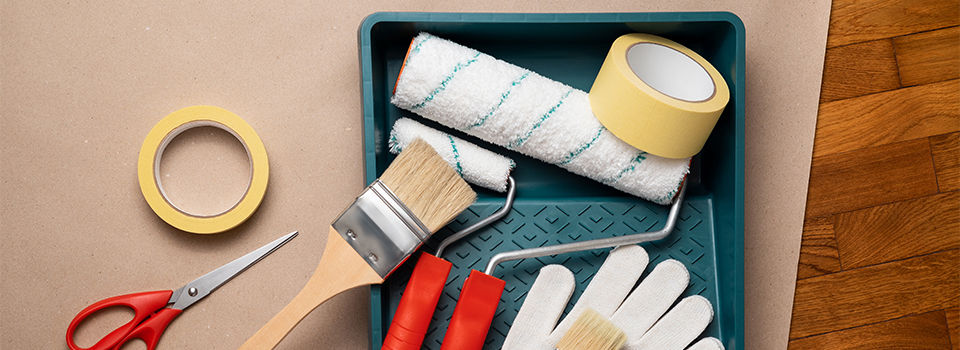
When to Use a Paintbrush
Paintbrushes are the go-to paint applicator, as they have been used for eons. They are easy to use and easy to clean (especially so with latex paint). Most jobs can be accomplished with a large brush (4”+) and a small brush (2”), making paintbrushes a good general-purpose choice for applying paint on both interior and exterior surfaces.
Paintbrushes come in a variety of sizes, styles and bristle types and each plays a part in the end result of your paint job. Small-sized brushes are ideal for working in smaller areas and for detail work, whereas large brushes are better when painting a larger surface. Use square or flat-tipped brushes for general painting projects because they can cover a large area in less time. Angular, or chiseled, brushes are ideal for cutting into corners and painting trim, molding and windows.
Bristle Types
Paintbrushes are made with either natural bristles or synthetic bristles, and each type works better with particular paint types and on particular surfaces. Choose wisely for the project at hand.
Use natural-bristle brushes with oil-based, alkyd paints, stains and varnishes. They don’t work well with water-based paints because the bristles get wet the same way hair does, and so become limp and less effective. Natural-bristle brushes also don’t work well on rough surfaces, which can break the bristles’ flagged ends.
Artificial-filament brushes, made from nylon or polyester or both, work well on rough surfaces and with any kind of paint. Nylon-filament brushes are durable and generally less expensive than natural bristle brushes. Polyester filaments are popular with DIYers because of their low price. They retain their stiffness better than any other kind of brush. The drawback is that because they are a stiffer-type brush they have less flex and leave more brush marks on surfaces. Also, they are not as easy to clean as nylon.
Nylon/polyester blends are the most popular synthetic paintbrushes since they combine the best qualities of both for great performance. The polyester bristles are used in shorter lengths for stiffness when using water-based paints; nylon bristles are used in longer lengths for precise tipping and durability during use.
Brush Quality
Better brushes hold more paint and therefore let you apply more paint with each stroke, plus they do it in a smoother fashion. They don’t leave brush marks and they hold on to their bristles. A first-time painter with high-quality brushes and rollers can do as fine a job as an experienced painter with cheap ones.
When looking for high-quality brushes, don’t rely solely on price. When in the store, check to make sure the brushes have:
- Flagged (split) ends. These provide a finer, more even finish.
- Flex. They should have a definite flex at their tips and spring back into shape.
- “Chiseled” bristles. They should have shorter bristles on the outside and longer bristles in the center, with a tapered appearance.
- Bristles 1-1/2 times as long as the width. The bristles on a quality 2″ wide brush will be at least 3″ long.
There should be no gaps in the bristles. When the bristles are pulled, no more than a few should come loose. If bristles pull out easily, the brush is probably poorly constructed.
Check brush ferrule quality (the ferrule is the metal part that attaches the bristles to the handle). Look at the way the ferrule is attached. The more securely it is attached, the better. Nailed-on ferrules are more secure than crimped ones. Also, look at the size. The wider the ferrule, the better. Check the ferrule’s type of metal. Tin ones usually rust quickly and are used on low-end, disposable brushes. Nickel-plated tin will rust, but does so more slowly than regular tin. These are used on good-quality brushes designed for extended use. Copper and stainless steel ferrules will never rust and last forever if properly taken care of.
Handles are either made of plastic or wood. Unvarnished, wooden handles are usually considered most comfortable because a painter’s hands don’t sweat as much when using them. And since wood is more textured, these handles don’t have to be gripped as hard. Check the handle shape as well. Flat handles have no contouring and so are not as comfortable for extended use. Kaiser handles are better because they are shaped to be more comfortable during a long paint job. Beaver-tail handles are best because the handles are thicker and better shaped for extended use.