Water Your Lawn
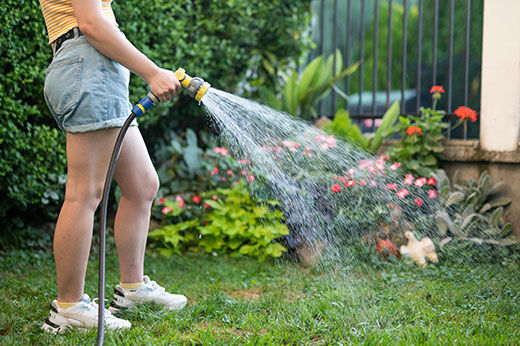
Every homeowner wants a lush, green lawn. In the summer heat, this requires regular deep watering. Consistent watering prevents the root structure of the grass from rising toward the surface in a desperate search for water, which makes the roots vulnerable and can harm or even kill the grass. At the same time, you don’t want to overwater. Standing water, combined with humidity, leads to fungus growth.
As a general rule, most lawns require about 1″ of water, once a week from rain or irrigation to penetrate down to the roots. This can usually be achieved by using a garden sprinkler, the most convenient and efficient method of watering a lawn. The length of watering time will vary, depending on how you irrigate your lawn. For example, different types of sprinklers saturate the ground slower or faster than others. Just remember that shorter, more frequent watering can produce a shallow root system which makes the grass more vulnerable to weeds and insects.
There are many sprinkler types, qualities and prices to navigate. A portable lawn sprinkler provides slow overhead watering for deep penetration, but it is important to select a sprinkler that fits the size and shape of your garden to avoid wasting water on the sidewalk through evaporation. Ask an expert at your local True Value hardware store for help deciding what’s best for your yard.
Your sprinkler’s watering rate should be set to about 1/2″ per hour. Anything faster will cause runoff in most soils. To determine just how much water your sprinkler is putting out per hour, use three empty tin cans (such as tuna cans) that are of identical size. Place them at different distances from the sprinkler, within the sprinkler pattern. Turn on the water for an hour, and then empty all water into one of the cans. Measure the depth of the water with a ruler or tape measure, and divide by three. This gives the amount of water your sprinkler supplies the lawn in an hour.
Helpful Tips
Water grass only when necessary; watch the weather to see if you’ll be getting any rain, and how much, during the week. You don’t need to water if the rain will do it naturally.
Here is a simple test to perform to determine if your grass needs watering: Walk on the grass. If you leave footprints, it needs watering. Moist grass springs right back, but dry grass doesn’t.
Grass turns a silvery blue in areas and, if not watered soon, will turn brown when it isn’t getting enough water.
Learn how to install an underground sprinkler system.
Try to water in the morning, rather than the afternoon or evenings. Watering in the morning when the sun is low and it’s cooler allows for better water intake. The afternoon sun can dry up the water before it has time to soak into the ground to the roots. Evening watering sometimes can be problematic, as it can encourage the spread of fungus and disease from the overly wet conditions.
Water Trees
Though trees are much more resilient than flowers or grass, you still need to pay attention to how much water they’re getting, especially as hot weather hits. One thing to keep in mind: Trees get much of their water from their massive network of fine roots, which quickly get saturated when water is available. So, just spraying a ton of water at the tree’s base with a garden hose doesn’t cut it because the root system isn’t absorbing it there. Most of the water will run off and not sink down deep into the roots. Instead, spray where the tree’s feeder roots are actively growing. These are the young tips at the outer edges of the root system that are actively taking up water and nutrients. They can be found at the outer edges of the tree’s drip line. The drip line is an imaginary line drawn from the canopy edge to the ground, where water would drip off the tree if it rained. You can also use a soaker or trickle hose to supply a slow, steady dosage at the drip line to maximize the tree roots’ water intake. A soaker hose is a perforated hose that you can wrap in a circular area around the tree’s root zone. Water trickles out of the network of holes in the hose to water the ground around it.
Newly planted trees and shrubs need a minimum of 1″ of water per week. Since a tree’s roots can extend 3′ or more below the ground, they should be watered with enough water so that it reaches that depth. For established trees, you can tell if they need water if the branches start to droop or the leaves wilt or curl and don’t recover overnight, or if you’ve had less than an inch of rain in a few weeks. During a drought, water deeply once or twice a week until the drought ends.