Step 1: Measure the Window
Use a tape measure to measure the bottom half of the window in which you want your air conditioner to go. Open the bottom sash all the way up when measuring. You don’t want to get the wrong size unit and find this out after you’ve lugged it around and heaved it up into the window. Be sure that there is an available outlet near the window to plug in the air conditioner.
SAFETY ALERT
Make sure the window frame and sill are sturdy enough to support the air conditioner. If the sill or other part of the window is cracked or damaged, repair it first before you put the unit in place, or choose another window. Window air conditioners are heavy. If not securely positioned in place, they can fall out of the window and potentially injure someone or damage property.
SAFETY ALERT
Don’t use an extension cord with a window air conditioner. The unit should be plugged directly into a proper outlet.
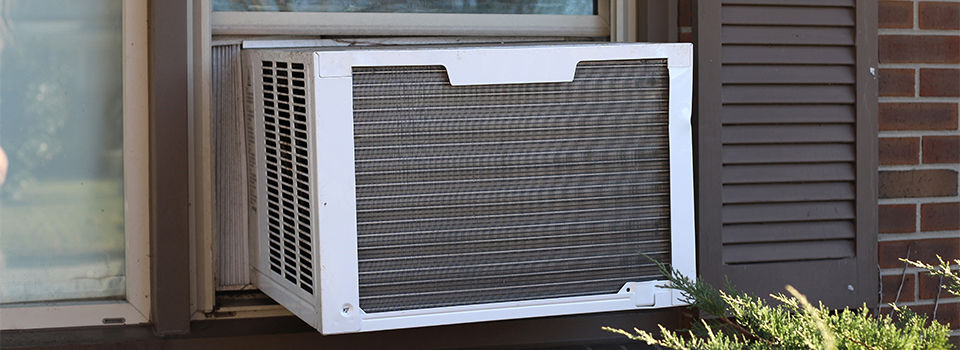
Window air conditioners come in a standard size to fit normal-sized window frames, but their size can change a fraction depending on the BTU output of the unit; for example, the more powerful your air conditioner is, the bigger it will be.
Keep in mind that window-mounted air conditioners are meant to work most effectively with vertical-closing, double-hung windows.
Step 2: Buy the Right Air Conditioner
When choosing a window air conditioner, your selection should be based upon the unit’s British Thermal Unit (BTU) rating — its cooling capacity. Window units range in size, usually from 5,000-BTU models to 14,000 BTUs (for normal home voltage).
Calculate the number of BTUs needed to cool a space by multiplying the square feet of the room by 25 and then adding 1,000 for every window, plus 400 for each person in the home. Example: A 10-ft. square (10′ x 10′) room with two windows and three people in the home would mean that 5,700 BTUs are needed.
You should strategically decide which room and window you want to use. You can get the most cooling potential and efficiency by placing the unit in a room that is connected to an adjoining space via an open doorway. When doing this, you want to count the square footage of both rooms as one space. Then, purchase an air conditioner with the necessary output. Air from your window unit won’t go around corners or through closed doors — plan unit placement accordingly.
HELPFUL TIPS
- It is very important to get the right size of air conditioner. One that has too much output will leave air feeling clammy and damp, whereas one that is too small will not remove warm air and cool down the space when it is very hot outside.
- Get more than one unit if you want to cool down more space. While one air conditioner can sometimes cool more area than just the room it’s in, to get better coverage, have at least two units to effectively cool down the most space.
- Try to choose a window free of direct sunlight. The sun’s hot rays beating down on the unit can make it work less efficiently and effectively.
Also, it’s a good idea to check the Energy Efficiency Rating (EER) of the unit. If the EER is not listed, it can be calculated by dividing the unit’s BTU output by the number of watts it requires to operate. A high EER rating is good because it means the air conditioner will run more efficiently, but the higher rating will come at a cost. If you plan to have the unit on most of the summer, it will pay to have a higher EER.